#66 in Best of the 21st Century?, a series counting down the most acclaimed films of the previous decade.
Hauptmann Gerd Wiesler (Ulrich Mühe) is a top Stasi agent, not the kind whose flashy skills and pride draw attention to himself, but the kind who quietly and methodically does his job, never questions authority, and seems to actually believe in the principles he operates under – or at least has never given them enough thought to really object. Then again, it’s hard to tell; the very reticence which makes him an ideal snoop and a hard-to-read interrogator means that we can’t quite be sure what’s going on in his mind: is he a loyal soldier, or merely someone who knows his place? German director Florian Henckel von Donnersmarck’s debut film, the 2006 winner for Best Foreign Film, The Lives of Others is about Wiesler’s slipping grasp on his own stoic rigidity, internal and consequentially external as well. The suggestive title conflates state-sanctioned snooping with sympathetic voyeurism, and indeed as Wiesler spies on a bourgeois artist couple, playwright Georg Dreyman (Sebastian Koch) and actress Christa-Maria Sieland (Martina Gedeck), his impassive surveillance gives way to emotional involvement – eventually one will have to give in to the other. Village Voice critic J. Hoberman has astutely noted the similarity to Wim Wenders’ seminal Wall- era Wings of Desire, writing, “No less than Bruno Ganz’s empathetic seraphim, Wiesler longs to be human.” Indeed, after listening in on a robust lovemaking session, Wiesler orders himself a home visit from a busy (and buxom) prostitute; though perhaps physically satisfying, it doesn’t quite scratch the spiritual itch Wiesler has been developing. Perhaps more telling is an encounter on an elevator just prior. A little boy, bouncing a ball casually asks Wiesler if he’s “really Stasi”; asked if he knows what this even means, the boy inadvertently informs on his father’s bilious characterization of the secret police. “What is the name of your f-” Wiesler stops himself, and pauses: “…of your ball?” The little boy chuckles and runs off, not knowing how close he came to turning the old man in. And Wiesler probably wonders what possessed him to show mercy, a quality he may not even have realized was within his power until now.
Continue Reading »
Showing posts with label movie review. Show all posts
The Gleaners & I
by Joel Bocko
#59 in Best of the 21st Century?, a series counting down the most acclaimed films of the previous decade.
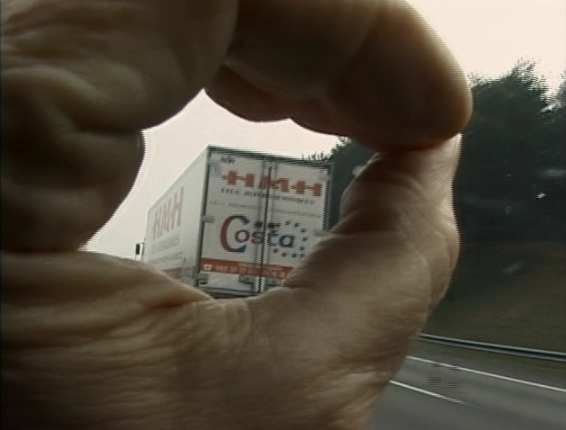
"Again one hand filming the other hand, and more trucks. I'd like to capture them. To retain things passing? No, just to play.In Agnes Varda's documentary The Gleaners & I (a more literal translation from the French would be "The Gleaners & The Gleaner", or even "Gleaneress") play, investigation, and contemplation are all intricately yet loosely wound together - each element distinct yet forming an upretentiously ambitious whole, much like the found-object artpieces Varda highlights throughout. Her subject, as you might have gathered (no pun intended), is gleaning: in all its forms. We are introduced to the classical gleaners, the peasant women who would follow the harvest by crouching and stooping through the fields, rummaging for leftovers once the more illustrious agricultural bounty was carried off. We see such gleaners in famous French paintings, and meet one or two who reminisce only - it seems that this more traditional form of gleaning has fallen by the wayside: mechanized reaping has become too precise and so few crops are left behind these days. This we learn in the first five minutes of the 90-minute film; what follows is an eager, inquisitive investigation of gleaning in all its latter-day manifestations...
Continue Reading »
L'Enfant
#57 in Best of the 21st Century?, a series counting down the most acclaimed films of the previous decade.
You’re about halfway through L’Enfant when you realize whom exactly the title refers to. Sonia (Déborah François) has just had a baby boy, and when the movie opens, she’s seeking the child’s father. He’s not at his apartment, which is occupied by a surly couple who slam the door in her face (a gesture that will be repeated throughout the film, although eventually she’s the one doing the slamming). When she finds him he’s on the street, wandering between cars stalled at a stop light, begging for change. Bruno (Jérémie Renier) is a scruffy young man, who could be anywhere from mid-twenties to early thirties. The indeterminacy of his age is telling; while his thick features suggest a manliness, his mop of hair, puppy-dog eyes, and perpetually mischievous grin suggest perpetual boyhood. Though Sonia is clearly his junior, she manages to mix a girlish playfulness (she’s constantly goofing around with Bruno, amidst shrieks of laughter) with a motherly concern for her new charge. Bruno, on the other hand, as soon as he’s left alone with the baby, tries to sell his own son.
Continue Reading »
You’re about halfway through L’Enfant when you realize whom exactly the title refers to. Sonia (Déborah François) has just had a baby boy, and when the movie opens, she’s seeking the child’s father. He’s not at his apartment, which is occupied by a surly couple who slam the door in her face (a gesture that will be repeated throughout the film, although eventually she’s the one doing the slamming). When she finds him he’s on the street, wandering between cars stalled at a stop light, begging for change. Bruno (Jérémie Renier) is a scruffy young man, who could be anywhere from mid-twenties to early thirties. The indeterminacy of his age is telling; while his thick features suggest a manliness, his mop of hair, puppy-dog eyes, and perpetually mischievous grin suggest perpetual boyhood. Though Sonia is clearly his junior, she manages to mix a girlish playfulness (she’s constantly goofing around with Bruno, amidst shrieks of laughter) with a motherly concern for her new charge. Bruno, on the other hand, as soon as he’s left alone with the baby, tries to sell his own son.
Continue Reading »
Tropical Malady
#55 in Best of the 21st Century?, a series counting down the most acclaimed films of the previous decade.
We’ve heard that love’s a bitch, and a battlefield, but in the 2004 Thai film Tropical Malady, writer/director Apichatpong Weerasethakul tells us it’s a tiger too. Or at least that’s one interpretation. Actually, at times it can be hard to know exactly what Apichatpong is after. As with the filmmaker’s later Syndromes and a Century (reviewed in a previous incarnation of this series), Tropical Malady divides neatly into two halves, but the way the halves relate to each other is different. In Syndromes, the different parts of the film are symmetrical, like parallel lines – they relate similar events in radically different surroundings. Malady on the other hand connects it’s first and second half with a joint and then lets them spin in entirely different directions, until the thread connecting them seems stretched awful thin. The two halves are perpendicular rather than parallel – maybe they’re better considered as two separate films, but here they are presented together, their interconnections left for us to tease out.
Continue Reading »
We’ve heard that love’s a bitch, and a battlefield, but in the 2004 Thai film Tropical Malady, writer/director Apichatpong Weerasethakul tells us it’s a tiger too. Or at least that’s one interpretation. Actually, at times it can be hard to know exactly what Apichatpong is after. As with the filmmaker’s later Syndromes and a Century (reviewed in a previous incarnation of this series), Tropical Malady divides neatly into two halves, but the way the halves relate to each other is different. In Syndromes, the different parts of the film are symmetrical, like parallel lines – they relate similar events in radically different surroundings. Malady on the other hand connects it’s first and second half with a joint and then lets them spin in entirely different directions, until the thread connecting them seems stretched awful thin. The two halves are perpendicular rather than parallel – maybe they’re better considered as two separate films, but here they are presented together, their interconnections left for us to tease out.
Continue Reading »
Elephant
#51 in Best of the 21st Century?, a series counting down the most acclaimed films of the previous decade.
Of the two most cited interpretations, the most frequent reading of Gus Van Sant’s enigmatic title holds that it refers to “the elephant in the room,” which nobody wants to talk about. Yet this is facile – was it really true that nobody wanted to talk about Columbine in the wake of the 1999 high school massacre? Was this true even beforehand, given that Columbine was actually the climax to a spate of school shootings, all of which received ample press coverage, rather than the kickoff? Furthermore, what exactly is it that’s not being discussed? Social isolation? The influence of the media? Video games? Gun control? Violence in America? Not only were all of these issues seized upon after the killings, but Van Sant makes a point out of eschewing all these explanations in his film (giving each of them a bit of airtime before moving on to other matters). So no, there’s no elephant in the room here, and if there is, no one’s ignoring it. The second reading, the one that it seems Van Sant actually intended, references the allegory of the blind men and the elephant, each touching a different part of the body and varying wildly in how they describe the animal. Likewise, Van Sant’s meditative, almost cruelly cool film is, at 81 minutes, too vast to take in from one perspective – which is not to say it’s particularly deep.
Continue Reading »
Of the two most cited interpretations, the most frequent reading of Gus Van Sant’s enigmatic title holds that it refers to “the elephant in the room,” which nobody wants to talk about. Yet this is facile – was it really true that nobody wanted to talk about Columbine in the wake of the 1999 high school massacre? Was this true even beforehand, given that Columbine was actually the climax to a spate of school shootings, all of which received ample press coverage, rather than the kickoff? Furthermore, what exactly is it that’s not being discussed? Social isolation? The influence of the media? Video games? Gun control? Violence in America? Not only were all of these issues seized upon after the killings, but Van Sant makes a point out of eschewing all these explanations in his film (giving each of them a bit of airtime before moving on to other matters). So no, there’s no elephant in the room here, and if there is, no one’s ignoring it. The second reading, the one that it seems Van Sant actually intended, references the allegory of the blind men and the elephant, each touching a different part of the body and varying wildly in how they describe the animal. Likewise, Van Sant’s meditative, almost cruelly cool film is, at 81 minutes, too vast to take in from one perspective – which is not to say it’s particularly deep.
Continue Reading »
Summer Hours
[#48 in Best of the 21st Century?, a series counting down the most acclaimed films of the previous decade.]
_________
“So we beat on, boats against the current, borne back ceaselessly into the past.”
_________
“I took her hand in mine, and we went out of the ruined place; and, as the morning mists had risen long ago when I first left the forge, so, the evening mists were rising now, and in all the broad expanse of tranquil light they showed to me, I saw no shadow of another parting from her.”
_________
“Poor Mole stood alone in the road, his heart torn asunder and a big sob gathering, gathering, gathering, somewhere low down inside him, to leap up to the surface presently, he knew, in passionate escape. … Meanwhile, the wafts from his old home pleaded, whispered, conjured, and finally claimed him imperiously. He dared not tarry longer within their magic circle. With a wrench that tore his very heartstrings, he set his face down the road and followed submissively in the track of the Rat, while faint, thin little smells, still dogging his retreating nose, reproached him…”
. . . . .
Summer Hours, The Decline and Fall of the French Bourgeoisie, Three Generations. Olivier Assayas’ absorbing and poignant film is first an observation of life’s fleeting moments (one might say it’s more observant than the characters who experience these moments, without really appreciating them). It is also a wailing elegy to a France crumbling away in the globalized world, letting its culture and its people dribble from its borders like sand from a smashed hourglass. And finally the movie is a portrait of one family, three generations (old, middle-aged, young) and three siblings in that middle group (brother, sister, brother), who slowly and willingly lose their country home, and with it their fragile communal identity. These two triumvirates, the generations and siblings, are each anchored in the center – chronological in the case of the age group (those in the middle of their life dominate the running time of the film), geographic in the case of the brothers and sisters (the deceased matriarch’s eldest son lives in France and tries to hold the family together, while his sister flees west to New York, and his little brother flees east to China). Alas, as is so often the case, the center does not hold.
Continue Reading »
Where the Wild Things Are
To a certain extent, great movies defy explanation. They pop up in the least expected place, ignoring conventional rules and expectations - they defy relevance (a quality I've just finished celebrating in another review) in the name of a deeper resonance. These films can often be ungainly, hard to swallow - they strike us at odd angles and approach us on their own grounds, not on ours. I think Where the Wild Things Are may very well be a great movie. It's certainly a visionary piece of work, highly original and unique, unlike anything else I saw in 2009. In this sense of difference, of vision, of effectiveness on its own terms, it reminds me of two (of course) very different movies: Inglourious Basterds and Antichrist. Together, they form a trilogy of challenging, rich, rewarding movies, all of which I had numerous problems with. Yet I could eventually and only embrace as examples of artistic accomplishment - among the most singular of this epoch.
Wild Things exists both as an aesthetic experience and a meditation on resonant themes: a combination most great narrative films employ. The screenplay, by Jonze and novelist David Eggers, sensitively "updates" Maurice Sendak's classic - respecting the power of the original while setting out on its own ground, and thus avoiding both of the traps most high-profile 00s adaptations have fallen prey to. At its core is a simple, eternal story: that of a child watching his innocence and exuberance slowly dissolve into the melancholy mists of pre-adolesence. He stomps around in his wolf suit, engages in goofy dances to make his mother laugh, acts more childish than his age should probably allow, but it's clear these are nostalgic gestures rather than unconscious actions, a display of imaginative naivitee to conceal the pain inside.
The movie creates several correspondences between the real-world opening and the surreal dreamscape of the Wild Things - a fort is crushed just like Max's snow igloo; a female monster runs off with her friends after the fashion of Max's sister; in climactic moments, tokens of affection are broken in both worlds - less as an act of hostility towards the original recipient of said tokens, than as a masochistic slaying of whatever was tender and guileless in the giver. Brilliantly, the movies does not spell out its central theme, the most important correspondence in the movie: between Max's relationship to Carol, a brooding, sensitive, sometimes brutal beast, and Max's connection to his absent father. The only sign of that missing paternal presence is a globe in Max's bedroom, which reads, "To Max, Owner of this World, love Dad." We never meet the man, but feel we get to know him through Carol (who spends the film yearning for a female friend grown distant; with a power that would dwarf a grown man, he lashes out in a childlike rage). The sense of displacement and repression only adds to the resonance.
Carol is a brilliant creation, a collaboration between James Gandolfini's sad, tentative, yet authoritative vocals and the expert mimicry of Jim Henson's Creature Shop (and, presumably, some digital enhancement to enhance the facial expressiveness). It's one of the great performances of the year; indeed all of the monsters are wonders to behold, fully realized characters crafted from singular traits and yet basted in larger-than-life warmth. By comparison, some of the human performances are a tad weak: Max Records is everything he needs to be as the star, but Catherine Keener's delivery is sometimes stilted (though her sensitive features work wonders in close-ups), and a classroom lecture about the end of the solar system feels forced and awkward.
The film skates just this side of mawkish cutesiness, going whole-hog for the childlike indie mood of current hip culture, with its Karen O vocals, earnestly Peter Pan-like nostalgia, and quirky sense of humor. It works, in part, because of the purity of its vision and because of Gandolfini's weighty presence - at times the actor's voice reminds us of another narcissistic boy-man who loomed large over the cultural zeitgeist, one prone to romanticism but hardly a sentimentalist. In his bruised self-pity and ferocious violence, Gandolfini makes the stretches of desert, wood, and beach on this magical island seem not so very far from the New Jersey Expressway. This aura of brooding darkness gives the film just the edge it needs to prevent it from sliding into the cozily blinkered worldview that has characterized creative youth culture in the past decade.
In the era of CGI, when Avatar's splashy debut is intriguing but frustratingly distancing spectacle, Spike Jonze has crafted a work with actual texture. While the film incorporates computer animation, it as an element in the overall design, a touch, not a template. Above all, the movie conveys the quality of being handcrafted - it has soul, and the soul is embodied on the very surface of the movie. This is not to suggest I fell into the movie's bear hug right away. Jonze initially employs a dizzying, off-centered compositional strategy - in the nighttime forest scenes, it's very hard to follow the action with all the whip-pans and blurred shapes moving through dark palettes. But when the camera moves out into the sun-speckled deserts and windswept beaches, it settles down somewhat and we can immerse ourselves in this world, which an IMDb commentator quite simply and effectively tags "a child's kingdom."
It's a kingdom made of sand, and the movie is content to watch, sadly but wisely, as the last granules of the sand castle are swept out to sea with Max's little wooden boat, away from the shore of dreams and into the wide world from whence he escaped, momentarily. Earlier in the movie, Carol takes Max to a secret hiding place, a cave in which he's built a miniature world (the scene plays as a tribute to Jonze's fellow music video auteur, the childlike genius Michel Gondry). "It's gonna be a place," he tells the boy wistfully, "where all the things you wanted to have happen...would happen." Jonze and Eggers are wise enough to flirt with but not indulge this fantasy wish. They allow us to visit a magical world, all the while reminding us of its fragility. Meanwhile reality to bangs at the door like a jackhammer, finally blowing into our sequestered little room, and sucking us back outside. But we remember what we've seen, treasuring the crumbs that we were able to grasp as if they were keys. Keys not only to a place of escape, but a pathway into something deeper than the everyday, where the roots of our vague stirrings and longings are planted. And that's art.
Wild Things exists both as an aesthetic experience and a meditation on resonant themes: a combination most great narrative films employ. The screenplay, by Jonze and novelist David Eggers, sensitively "updates" Maurice Sendak's classic - respecting the power of the original while setting out on its own ground, and thus avoiding both of the traps most high-profile 00s adaptations have fallen prey to. At its core is a simple, eternal story: that of a child watching his innocence and exuberance slowly dissolve into the melancholy mists of pre-adolesence. He stomps around in his wolf suit, engages in goofy dances to make his mother laugh, acts more childish than his age should probably allow, but it's clear these are nostalgic gestures rather than unconscious actions, a display of imaginative naivitee to conceal the pain inside.
The movie creates several correspondences between the real-world opening and the surreal dreamscape of the Wild Things - a fort is crushed just like Max's snow igloo; a female monster runs off with her friends after the fashion of Max's sister; in climactic moments, tokens of affection are broken in both worlds - less as an act of hostility towards the original recipient of said tokens, than as a masochistic slaying of whatever was tender and guileless in the giver. Brilliantly, the movies does not spell out its central theme, the most important correspondence in the movie: between Max's relationship to Carol, a brooding, sensitive, sometimes brutal beast, and Max's connection to his absent father. The only sign of that missing paternal presence is a globe in Max's bedroom, which reads, "To Max, Owner of this World, love Dad." We never meet the man, but feel we get to know him through Carol (who spends the film yearning for a female friend grown distant; with a power that would dwarf a grown man, he lashes out in a childlike rage). The sense of displacement and repression only adds to the resonance.
Carol is a brilliant creation, a collaboration between James Gandolfini's sad, tentative, yet authoritative vocals and the expert mimicry of Jim Henson's Creature Shop (and, presumably, some digital enhancement to enhance the facial expressiveness). It's one of the great performances of the year; indeed all of the monsters are wonders to behold, fully realized characters crafted from singular traits and yet basted in larger-than-life warmth. By comparison, some of the human performances are a tad weak: Max Records is everything he needs to be as the star, but Catherine Keener's delivery is sometimes stilted (though her sensitive features work wonders in close-ups), and a classroom lecture about the end of the solar system feels forced and awkward.
The film skates just this side of mawkish cutesiness, going whole-hog for the childlike indie mood of current hip culture, with its Karen O vocals, earnestly Peter Pan-like nostalgia, and quirky sense of humor. It works, in part, because of the purity of its vision and because of Gandolfini's weighty presence - at times the actor's voice reminds us of another narcissistic boy-man who loomed large over the cultural zeitgeist, one prone to romanticism but hardly a sentimentalist. In his bruised self-pity and ferocious violence, Gandolfini makes the stretches of desert, wood, and beach on this magical island seem not so very far from the New Jersey Expressway. This aura of brooding darkness gives the film just the edge it needs to prevent it from sliding into the cozily blinkered worldview that has characterized creative youth culture in the past decade.
In the era of CGI, when Avatar's splashy debut is intriguing but frustratingly distancing spectacle, Spike Jonze has crafted a work with actual texture. While the film incorporates computer animation, it as an element in the overall design, a touch, not a template. Above all, the movie conveys the quality of being handcrafted - it has soul, and the soul is embodied on the very surface of the movie. This is not to suggest I fell into the movie's bear hug right away. Jonze initially employs a dizzying, off-centered compositional strategy - in the nighttime forest scenes, it's very hard to follow the action with all the whip-pans and blurred shapes moving through dark palettes. But when the camera moves out into the sun-speckled deserts and windswept beaches, it settles down somewhat and we can immerse ourselves in this world, which an IMDb commentator quite simply and effectively tags "a child's kingdom."
It's a kingdom made of sand, and the movie is content to watch, sadly but wisely, as the last granules of the sand castle are swept out to sea with Max's little wooden boat, away from the shore of dreams and into the wide world from whence he escaped, momentarily. Earlier in the movie, Carol takes Max to a secret hiding place, a cave in which he's built a miniature world (the scene plays as a tribute to Jonze's fellow music video auteur, the childlike genius Michel Gondry). "It's gonna be a place," he tells the boy wistfully, "where all the things you wanted to have happen...would happen." Jonze and Eggers are wise enough to flirt with but not indulge this fantasy wish. They allow us to visit a magical world, all the while reminding us of its fragility. Meanwhile reality to bangs at the door like a jackhammer, finally blowing into our sequestered little room, and sucking us back outside. But we remember what we've seen, treasuring the crumbs that we were able to grasp as if they were keys. Keys not only to a place of escape, but a pathway into something deeper than the everyday, where the roots of our vague stirrings and longings are planted. And that's art.
Labels:
movie review,
response
Stromboli
(Though already written before I was aware of the series, I am now submitting this as an entry in the For the Love of Films: Film Preservation Blog-a-Thon of Ferdy on Films & Self-Styled Siren. A full-fledged entry will be appearing on the Dancing Image on Sunday, the last day of the blog-a-thon. Stay tuned.)Despite seeing many of his films, I've never really responded to Rossellini the way many cinephiles do. His holy simplicity has occasionally struck me as, well, just plain simple. Flowers of St. Francis (a blind buy on my part, and a satisfying one) is charming and Voyage in Italy compelling - though I wonder if Antonioni didn't eventually pick up Rossellini's ball and run further with it a few years later. Europa 51 I found embarrassing and remain rather mystified as to how its obviousness is supposed to be transcendent. Open City and Germany Year Zero are effective and absorbing but they're films I respected without being enthralled by. Neither one seemed to capture the lingering, simple, pure power of Bicycle Thieves (though both are overripe for revisiting, especially in the wake of the recent Criterion releases). Paisan was compelling in the abstract but I found its actuality too messy. Unlike Rossellini's acolytes (one recalls the zealous cineaste in Before the Revolution who admonishes the protagonist, "Remember, Rossellini is a god!") I was always unable to take the raggedness of his work in stride, to embrace it as not just a necessary evil but somehow fundamental to the work's appeal.
All of which is preface to my enthusiastic viewing of Stromboli. Rossellini's first film with his new (and newly controversial) wife Ingrid Bergman, it's bursting with energy, invention, and showmanship. The film ripples with rich tensions, between its desire to simply document village life and its allegorical overtones, between frustration with Bergman's spoiled character and sympathy with her own frustrations, between the melodramatic extremes (heightened by the literally incessant music which at one point pounded consistently for about half an hour!) and documentary naturalism. Certainly between Bergman's professionalism and glamor and the untrained "performances" of the nonactors in the movie - a healthy balance is struck here, with the real people convincingly inhabiting their characters and a terrific Bergman dialing down her polish while turning up her acting chops. The provincial folks and the Hollywood goddess gel remarkably well.
The centerpiece of the film perfectly demonstrates the subtle synthesis of Rossellini's artistry with his method of understated observation. A squad of fishermen are out at sea, as they are every day, but this time Bergman's character is out there with them to observe their activity. Slowly, as they pull in their nets, shapes begin to emerge beneath the watery surface, and then a chaotic explosion of whitewater and flailing fins. I had experienced this scene years ago, excerpted in Martin Scorsese's "My Voyage to Italy" and been blown away. Oddly enough, I couldn't quite remember why anymore. Now it came flooding back - these fish are gigantic! Their capture and seizure is brutal, violent, beautiful; the set piece is so strong that it overpowers everything else. Allegorical readings are possible but unnecessary - the forcefulness of the scene empowers the rest of the film rather than vice versa. The way a note will shift the "meaning" of a piece of music without our being able to articulate exactly why, so this sequence prepares the way for Bergman's journey across the volcano in the film's climax.
The ending is very abrupt, but of a piece with the movie's ragged, punchy, honestly intense and intensely honest effect. This is that rare and satisfying discovery - when an auteur's appeal becomes apparent not in a mitigation of their usual approaches but in taking these approaches to their extreme and making you see, in the burning light of their purity, what they were up to all along. The film is like its titular volcano, not exactly dormant, not exactly active, but rumbling, quaking, occasionally erupting in spurts - in short, living but limned in by all the limitations which usually encumber life though they need not extinguish its flame.
It occurs to me that, in speaking in abstract and vague terms about the movie's appeal, I may be doing it a disservice. Perhaps a better approach would be to tackle it in clear, precise, yet pungent language, language which mirrors the film's own aesthetic. This may be the case, yet having seen it about a month ago, I'm trying to recollect its fragments, like lava rocks in the wake of an explosion.
Anyway, see it if you can.
Donate to the National Film Preservation Foundation.
Howard Zinn: You Can't Be Neutral on a Moving Train
Just as Howard Zinn, the famed Boston University professor and historian who wrote The People's History of the United States, felt it was impossible to be "neutral" and undesirable to be "objective" about human history, so it's been near-impossible for anyone to be neutral about Zinn himself. The Left adored him; the Right loathed him. The historical community seemed split between those who felt he added a stirring chorus of voices to the historical choir (helping to popularize history amongst a general readership in the process) and those who rankled at his methods and tone, feeling that he was not playing by the proper rules of the game. When Zinn passed away a few weeks ago, of course, the emphasis was on the positive and the same is true of this documentary which was released around 2003, a time when Zinn's call for dissidence seemed more relevant than ever.Much as I enjoy elaborating and extrapolating, sometimes a simple blurb says it best. (Not that I'm going to keep it short myself here; in my defense, neither would Zinn - A People's History runs 682 pages!) In this case the blurb is J. Hoberman's. The Village Voice critic (himself of a definite leftward tilt, though not of the populist variety) wrote of the film, "Deb Ellis and Denis Mueller's fond portrait, less documentary than infomercial, is unrelentingly and in the end self-defeatingly positive -- albeit effective in showcasing Zinn's charismatic personality." That about sums it up - though I'd add that the doc is also hindered by an amateurish and rather ineffective style. Still, it's primary purpose is to provide a snapshot of Zinn's life and personality, and it does achieve this, particulary when it comes to the professor's early and middle years.
As a rightward-leaning high school student (partly the contrarian in me, as most of my peers seemed to be liberals, and knee-jerk ones at that) I often found Zinn's work irritating. Contrary to the notion that Zinn's radical re-evaluation of history remains anathema in hidebound American education, A People's History was assigned reading in several of my classes. Open-minded despite my skepticism towards the left, and genuinely curious as to where they were coming from, I would dig into a fresh chapter eager for a bracing subversion of American mythology. But by the end of each I found myself wearied by the monotony of Zinn's focus on exploitation and victimization, the contrary stubbornness of Zinn's refusal to grant quarter to any American leader as anything other than an dictator in disguise, and mostly by the lack of an intellectual tension or complexity in the work, something I relished even then. Though I still appreciate this quality above all others, in history, in art, in just about anything, I'm much more open to Zinn's approach now.
Re-reading A People's History in the wake of Zinn's death (I'm about 150 pages in at the moment) I no longer find it wearying but completely absorbing. The focus on the economic imbalance and abuse of those with less power seems more like a provocative and openly admitted bias, one which gives the narrative drive and clarity though it certainly works better in some passages than in others. (The colonial years are convincingly rendered via one long cry of moral outrage, directed at the barbarism of a greedy and ruthless culture whose cruelty was only matched by its hypocritical arrogance. However, when it comes to Revolutionary times, the author has trouble portraying Jefferson as essentially an elitist, one whose intellectual adventurousness and passion for liberty were basically beside the point. Even as Zinn struggles to demystify the words of the Declaration of Independence, the quoted passages remain stirring.)
I mention this as a segue back into Zinn's character. Underpinning the seeming one-sidedness of his focus are two qualities which are often missing on the intellectual left: a personal complexity in terms of his relation to the country he's criticizing, and, conversely, a simplicity and moral straightforwardness which is in the best tradition of American radicalism. On the first note, Howard Zinn was an antiwar activist who had fought and killed in war, a fierce critic of air bombardment who had himself been a bombardier in World War II. His positions were not so much contradicted by his history, as necessitated by them; it's quite possible that if he could have re-lived his life he would not have served, but his story is far more compelling in the fashion it occurred: it gives him a moral authority which stems from humility, humanity, and experience. He is not hovering above what he condemns, pointing the finger from a place of purity (like some of the college kids who jeered at soldiers without ever having been in their shoes, either literally or conceptually).
Likewise, Zinn was not an academic theorizing about the working classes after receiving a healthy dollop of Marxism, he was a slum kid who worked menial labor for years before attending college on the G.I. Bill (while struggling to support his growing family). Hence his championing of the underdog was not merely a self-loathing nose-thumbing at the bourgeoisie, as it seemed to be with so many sixties intellectuals. This may also explain his much-noted good cheer and patience with opposing views, at least according to those who experienced him as a teacher. His revisionism was bucked up by a history of patriotic service (however much he questioned it later), and - despite his unwavering criticism of those in power - a relative deficiency of personal bitterness (in the sense that Zinn tended to see almost everyone as tangled in the web, even to a certain extent the spinners). This leads to one of the film's most compelling moments (though it bungles the delivery, it can't really taint the fascination of the anecdote). In North Vietnam to receive some POWs whom the Communists have agreed to release, the representatives of the peace movement (including Father Berringer and Tom Hayden) are invited to sing, as is the tradition at Vietnamese gatherings. Zinn stands up and sings "America the Beautiful."
The later years, following Zinn's involvement in the civil rights and antiwar movements, are not as compelling when presented in the documentary. Zinn's feud with BU president John Silber is a potential source of drama, but it's defused instantly when, after beginning to develop the conflict, the filmmakers tie the story up quickly with a rather rambling response by Zinn in a lecture hall. In this and a later speech, Zinn dismisses his critics through guilt-by-association (talking about a historian who criticized his work, he haltingly begins to engage the historian's criticism and then falls back on, "He supported Nixon" and the film leaves it at that). This was the favored tactic of Zinn's more right-wing enemies ("he's a Marxist" or "he's a radical leftist" therefore his arguments must be wrong) and it's no more satisfying coming from Zinn than from them. Indeed, as the filmmakers document Zinn's dogged dedication to dissidence, they ironically display the American left's descent into something of an ideological rut.
Contrary to the teeming mass of freshly radicalized students we see in newsreel footage from the civil rights and Vietnam era, the crowds at the Iraq rallies and book presentations which close the film give the impression of having made up their mind long ago. Asked what she thought of Zinn's talk, one young woman says she liked it because "it basically confirmed everything I already thought." This is a far cry from Zinn's earlier intention to rattle the public's complacency and turn the way students and historians approached the past - and the present - on its ear. To be fair, Zinn himself did not want to preach to the converted; he's shown at one point inquiring, "Are there lots of people there who haven't made up their minds yet? 'Cause those are the people we need, the ones we want to reach." He's assured this is the case, yet in the crowds we see it looks like the usual suspects, clothed in the garb and speaking the language of the self-enclosed guardians of the flame. The heirs of the New Left are no longer new, and their world has become as sterile and fixed as that their progenitors rebelled against.
Anyway, to the end Zinn remains a charismatic presence - and the film, narrated by Matt Damon (who famously name-dropped his Cambridge neighbor in Good Will Hunting), is most successful at giving that presence a channel through which to communicate. Whatever his flaws, the left today could use a healthy dollop of Zinn's good humor, moral clarity, and most importantly and suprisingly, his all-Americanness. Zinn's ideal Left was less one which thrived in a brooding marginalization and alienated sense of "difference" than one which sought to demolish senses of difference, to establish an underlying humanity, and to reclaim the United States for "the people". A mere Marxist catchphrase for many (their particular misanthropy belying their vague anti-elitist rhetoric) the notion of "the people" seemed to have real meaning for Zinn. At his best - which is what I'd like to focus on here, given his recent passing and my renewed appreciation of his work - he can remind even those skeptics among us of radicalism's moral foundations, and constructive potential.
Labels:
movie review,
politics,
response
Bed and Sofa
Husband and wife are lying in bed, early in the Moscow morning. Kolia (Nikolai Batalov), the husband, is up first, groggy but awakened by the couple's energetic pet cat, who's leapt onto the bed. Mischievously, he grabs ahold of the kitty and shoves it in his sleeping wife's face. Liuda (Lyudmila Semyonova) reacts as any interrupted sleeper would, batting it away and jerking up from her comfortable recline. Rubbing her eyes, smoothing down her bobbed hair and bangs, she glances at the grinning man-boy in bed next to her with a mixture of amusement and irritation. He laughs, but he's playing with fire by provoking her so. Before the day's over, he'll have introduced a creature much more threatening into the marital bed, even if old Red Army buddy Volodia (Vladimir Fogel), visiting from out of town, is initially relegated to the sofa.Silent films and early talkies are often more provocative than the movies which followed (due to state censorship in Germany and Russia, the Production Code in America). Still, how many silents can you remember which stage their climax in an abortion clinic? Bed and Sofa, a 1927 sex comedy/drama (even its genre is not clearly delineated) engages most of the taboos: abortion, adultery, divorce, free love, menage a trois - all that's missing is homosexuality (though this certainly comes to mind amidst a long kiss on the lips, during which Volodia, embracing Kolia, thinks he's kissing Liuda; the conclusion, which finds the two men alone in the room, deciding who'll sleep where, also hints at this subtext). Indeed, this is a film where the wife's affair is revealed halfway through the movie - in most melodramas it would lead to a climactic fight; here it only begins the roundelay which finds both men passing in and out of the woman's affections and between her bedsheets.
Unlike with Jules and Jim, it is not the woman whose fickleness is made to seem crazy, but the men whose bullheaded pushiness makes us sympathize with Liuda. Embodying both Jazz Age and Slavic ideals, with her modish Louise Brooks hairdo topping a stockier, more boxy build, Liuda is torn between her attraction to the two workers who claim her affections - to the comforts of Kolia and the novelty of Volodia - and her frustrations with both of them. Meanwhile, an ominous portrait of Stalin - who had only just taken power in '27 - hangs on the wall alongside a calendar. Initially this seems like a necessary political gesture on the filmmaker's part, but eventually it leads one to tease out allegorical resonance in the onscreen threesome. Could Liuda be like the young Soviet Union, volleyed back and forth between different leaders who claimed her loyalty? Just as Stalin would eventually erase deviant Bolsheviks from Party history (he was already beginning to do this with Trotsky), Liuda replaces Kolia's portraits with Volodia's all around the room (Stalin, of course, stays put).
Whether or not all the picture-swapping is supposed to have political ramifications, it pays off dramatically in the end. Liuda rushes home to an empty apartment from the abortion clinic (where she went, not out of her own desire to end the pregnancy, but at the behest of her beaux, who jealously regard the incipient infant as the other man's). There she writes a goodbye note and takes her own picture out of its frame, at once liberating both her image and her body from the home where her initially adventurous sexual experiments came to be one more form of imprisonment. The movie concludes with the two male saps, one on the bed, one on the sofa (they've been switching back and forth throughout the movie) wondering what to do next. Meanwhile, Liuda leans out the train window, breathing the fresh air and rushing out of town just as we saw Valodia arriving in the beginning (his train bears him into Moscow, to borrow Churchill's characterization of Lenin's similar journey in 1917, "like a plague bacillus").
The film is composed of concrete units, a series of two-shots, close-ups, and inserts of important objects (or cats). The camera punches in and out of different elements within the scene, and switches angles without any movement. Not as reliant on the abrasive qualities of montage as were Dziga Vertov and Sergei Eisenstein, director Abram Room utilizes editing to create a sense of space and drama, and divisions within both. Scrolling through the images on Netflix (where the film is available for instant viewing) I was surprised to discover that there are almost no shots featuring all three protagonists together - it's usually Liuda with Kolia, or Liuda with Valodia, or the two men with each other.
This subtly heightens the sense of claustrophobia, visualizes the trio's inability to accomodate one another, and highlights the film's assembly through relational cutting rather than juxtapositional montage or single, wide shots. Likewise, the movie is dialectical but not as aggressively or obviously as Eisenstein's works. Aside from the dichotemy of the title, Bed and Sofa opens and closes with the rushing train, features an airplane ride above - but significantly not out of - Moscow in the middle, and punctuates its narrative with comical and often symbolic feline interludes. The film is almost entirely enclosed in the apartment and various workplaces, but is bookended with outdoor sequences.
Ultimately, the portrait of Stalin is telling. Bed and Sofa seems to have its ear to the ground, and it buries both its style and even to a certain extent its message (both quite modern) beneath the cover of conventional storytelling. Soviet films would have to just that to survive in the years to come, yet even this subterfuge would not be enough. Liuda's quite fortunate in the end, to be escaping from the scene of her entrapment...her country, and its cinema, would not be so lucky.
Labels:
movie review,
response
The Lost Weekend
(Originally published on the Examiner in October 2009, this review has been moved here in its entirety.)Don Birnam (Ray Milland) is a writer - in theory - and an alcoholic - in indisputable fact. Coming off a bender, telling himself he's finally going to write that big novel, Don's itch to drink is palpable as his brother (Phillip Terry) helps him pack up for a restful long weekend in the country. Instead, drawn to booze with the stubbornness of a boomerang, Don ditches his brother and his long-suffering girlfriend (Jane Wymann) to gulp down several shots of whiskey at the local establishment. Don, who was uptight and irritable in the first scene, loosens up, waxes eloquent on the wonders of whiskey, and flirts with a sassy hooker who picks up johns in the bar. It's a clear and effective depiction of why drinking appeals to this insecure artist - and it will be the last such moment. Having presented the magical deliverance of the ennui-quenching rye, writer/director Billy Wilder and co-writer Charles Brackett proceed to display, in merciless detail, all the drawbacks of the addiction. Don becomes a kind of 40s Dante in reverse, descending from brief intoxicated Paradise, through a purgatorial search for satiation, and finally into the depths of DT Hell. Only his longtime lover can hope to rescue him from the depths of his own self-hatred, of which the hard drinking is both partial cause and persistent symptom.
Compulsively watchable, with its strong performances (especially from Milland, who manages to be both pleasingly theatrical and harrowingly natural), juicy dialogues and monologues, and its de facto structure. The use of a single weekend as a framework (although the filmmakers cheat a bit by using flashbacks) focuses the action and makes Don's decline from sobriety through every stage of drunkenness to suicidal withdrawal all the more effective. The Lost Weekend is a very good movie, but it isn't great - and it's one of those films which can be frustrating to watch at times, because you can sense greatness within its grasp. Though the flashbacks are effective in laying out Don's pathology and explaining his mysterious relationship to Helen (whose affection for him and patience with him initially seems unwarranted), one wishes a less artificial construct could have been found. The film is sharpest when it stays on its one-weekend timeline, and when it unfolds by keeping pace with its hero's descent. Even the flashback photography is not as precise and focused as the images of the "present" - as if Wilder and fantastic cinematographer John F. Seitz were aware that their explanatory history wasn't as strong as their demonstrative real-time. There's also an overemphasis on explaining the addiction, which is after all as much chemical as anything else, but one is tempted to forgive the frequent psychological self-analysis, as it's so artfully written.
The film was marked as "realist" at the time of its release, when it won an Oscar for Best Picture in 1945. However, "realism" is not the same as "reality" and part of the film's appeal lies in the friction between the pleasures of Hollywood style (despite its location shooting, the films falls safely within the framework of studio filmmaking) and the darkness of the subject matter. The classicism gives us an familiar frame within which to view the grim reality of alcoholism, and The Lost Weekend is all the more effective for it. Like many thematically ambitious films, it dates more than movies which may have seemed less "edgy" and "relevant" at the time - when it lectures, explains, or at times overdramatizes Don's drunkenness it can seem out of touch. Mostly, however, the movie is still stirring, evocative, and engaging. The bat in that infamous scene does look embarrassingly fake, but the set piece has a great, grisly finish which still sickens. An excellent movie, flawed but a classic.
(Incidentally, many will adjust the balance more in favor of the latter than the former - take Tony d'Ambra, curator of filmsnoir.net, with his marvellous and celebratory write-up on the movie; you should absolutely follow the link for a more in-depth view of the movie.)
Labels:
movie review,
response
The Lost Son of Havana
(Originally published on the Examiner in July 2009, this review has been moved here in its entirety.)Thirty years after the chants of "Lou-eee, Lou-eee!" have faded from Fenway, six miles from the spot of a very important and long-awaited 1975 reunion, the National Amusements Showcase Cinemas in Revere screened The Lost Son of Havana in Theater 1 at 7:35 pm; one of four daily screenings for at least the remainder of the week (if it is not held over any longer). The name of the movie was left out of the "Now Playing" flyers adorning the lobby, and there weren't any placards emblazoned with large quotes from Entertainment Weekly or video installments running trailers in loops. When asked for a ticket to the film, one of the theater's employees warned, "You do know it's a documentary, right?" Apparently, this disclaimer was necessary: some customers have been complaining. No one complained on this particular night, though - the four other people in the near-empty theater seemed perfectly content with their choice of entertainment.
If you do know it's a documentary, and you don't mind, please go out and catch this moving and very enjoyable picture, which observes beloved Red Sox pitcher Luis Tiant's career, family life, and return trip to Cuba after 46 years in exile from the impoverished Communist island on which he was born and raised. Tiant's upright dignity is colored by a wry humor and pride, and also by a looming melancholy, and his charisma carries you along for the hour and forty-five minute running length. The filmmakers (director Jonathan Hock, backed by the Farrelly brothers, of all people) get out of their subject's way - the style is not flashy (though occasionally grainy film stock punctuates the video footage to represent Tiant's subjective impressions; it's a nice and subtle effect). The structure is the by now traditional call-and-response of the present (Tiant's visit to Cuba) and the past (his dogged up-and-down career in the majors); there is a narrator (the ever-dignified Chris Cooper) but he only steps in to introduce photos and footage from the 60s and 70s, tending to efface himself when the now elderly Tiant is onscreen.
Tiant is a man who has not had one athletic career, but several. First there are the years in Cuba, building up his skill, while his father - once a player in the American Negro leagues (the narration lyrically describes "seventeen summers on the backroads of America"), and a genuinely great one at that, considered by some a greater pitcher than Satchel Paige - hides in the bus roundabout across the street, watching his son play in the park despite his own disapproval of the boy's dreams. Then Tiant goes to the U.S. - and stays there when Cuba clamps down the door on ballplayers, insisting they either give up their dreams of a professional career and come home, or else abandon Cuba for a U.S. career. Tiant, with his parents' approval, chooses the latter path, and while this ensures all that is to come, to this day he seems to feel he must make excuses, and occasionally he voices mournful shame over what happened.
At any rate, success is by no means immediate. For a while he follows his father's path, playing across the Jim Crow South, and though civil rights breakthroughs were on the horizon, Tiant recalls the virulent racism of the time - another reminder that the trading-family-for-freedom narrative is not so simple as that. When he breaks in to the big leagues, he breaks in big time, pitching no-hitters, developing not one but two signature pitching styles, rising and falling between the majors and the minors, becoming a star, becoming a nobody, and becoming a star all over again...for those who are unfamiliar with the story, I will say no more, and let the movie work its magic on you. While many of Tiant's accomplishments would be at home in a feel-good sports flick, there are constant reminders that reality is messier: a powerful moment before the World Series followed by disappointment; ultimately, an inevitable fading from the scene despite comebacks; most importantly, a muted fatalism and sadness detected in Tiant's countenance.
All of this only makes the miracles that much more amazing, and the movie climaxes as Tiant's family life, the political relations of the U.S. and Cuba, and the baseball fortunes of the Red Sox converge in the autumn of '75, in a formulation that no fictional screenplay could get away with. Meanwhile, of course, the film cuts back to Tiant as a much older man, quietly surveying the baseball aficionados in Havana who, asked about the greatest Cuban exile ballplayer, come up with many other names before they remember his. His reunions and reconnections with old family and friends are emotional, but more in a quietly sad key than with a celebratory tone.
Early passages in the movie are informed by a firmly anti-Castro tone, a bit overbearing in Cooper's narration and in some of the bleak footage, but politics are neither the filmmakers' nor Tiant's concern; frustration and anger with the Castro regime's imprisonment of Cubans on their island (and in a decaying version of the past, a kind of national arrested development which foreigners seem to find romantic, but which many Cubans themselves appear frustrated by) give way to simple observation, with the emphasis on endurance and empathy, but in surprisingly uncloying ways. Repeatedly, the film eschews sentimentalism: though Tiant's family welcomes him with admiration and love, some old neighbors scold him with tears in their eyes for abandoning them - meanwhile, elderly aunts feebly remember the years lost and, in some sense, wasted, while younger cousins flat-out ask Tiant for money. Looking at their severely decayed surroundings, we do not wonder at it (and neither does he, providing the bills they require).
This is in keeping with the spirit of the man, whose determination is laced with regret, whose withheld feelings slip out from behind his reflective shades and can be glimpsed beneath his drooping gray mustache. In one scene, Tiant's narration informs us that he does not believe in an afterlife, even as the camera pans to a crucifix in his car; in this man's life, God exists to help one make it through, but there is no reward waiting on the other side. All that you have is what you make, what you've lost can never be regained, and yet one cannot linger over regrets for that very reason. That a few viewers have wandered out of the theater, apparently dismayed that they weren't seeing Transformers 2, is probably something Tiant could handle; he's been through much worse. The fact that his story is onscreen at all is triumph enough - and the experience is not to be missed.
Labels:
movie review,
response
The Leopard
(Originally published on the Examiner in August 2009, this review has been moved here in its entirety.)If Italian films from the forties and fifties were dominated by a hard-bitten look at the present, with a transforming Italy moving from fascism and war through poverty and ruin to the cautious construction of a modern postwar world, then Italian cinema of the sixties can be seen as one long, mournful elegy for the lost past, in a variety of different keys. At the dawn of the decade, neorealism had already been relegated to the past, but that movement's overarching social critique and devotion to intense observation of daily life continued to inform works crafted by the best Italian directors. These qualities were put to work in a series of wildly different yet equally powerful films, which together paint a coherent picture of a nation caught in the whirlwind, its people having severed their roots once and for all, yet unable to establish connections to the new world being born around them.
Ermanno Olmi, in Il Posto, tracked an upwardly mobile member of the working class as he moved into a professional job, finding the financial security that his family lacked. Yet in order to gain tenuous ground in an uncertain future, he was leaving the familiarity of a more traditional world behind. The fiery Pier Paolo Pasolini's characters had far less opportunities, but were no less driven - often into self-destruction. In his Mamma Roma, it is not the world which is fluid and unstable, but the people in it, represented by the cut from the wild grieving of a heartbroken woman to the static cityscape out her window. Solid and implacable, the vista may mock her ferocious energy and ambition, may even defeat it, but such energy could not be negated - Italians were on the move, whether or not Italy itself was ready or open to such movement. (This sensation was also evoked earlier in the film, as an adolescent roamed through a hilly landscape dotted with looming stone monoliths, their weirdly erratic stability contrasted with his - and the camera's - restlessness. The tense, plangent classical score on the soundtrack echoed his own inner stirrings.)
Of course there was Michelangelo Antonioni, whose highly formalist portraits of alienation also juxtaposed humans to landscapes, though in this case they seemed to cower, uncertain in the face of looming reality. Not content to let these implications speak for themselves, the writer/director of L'Avventura stated his intention baldly and boldly: "And today a new man is being born, fraught with all the fears, terrors and stammerings that are associated with a period of gestation." Even the fantasist - and (hence?) most popular of the Italians - Federico Fellini - focused his two crucial early sixties works, La Dolce Vita and 8 1/2, on anxiety caught in the cross-hairs between past and present, desire and responsibility. Meanwhile a younger generation, even less situated in Italy's past than its elders, regarded the last holdovers of an old society with a mixture of bitterness and nostalgia. The bitter was best represented by Marco Bellochio with his scathing debut Fists in the Pocket - a brutally funny, and frightening, screed against the nuclear family in which the rebellious and murderous outbursts of our protagonist, initially seeming free-spirited, were eventually revealed as the self-realization of a fascist.
And then there's the nostalgia. Two directors, one very young, one middle-aged, looked longingly upon the trappings and conventions of civilized life, even as they ambivalently touted the revolution. Ironically, it was the younger of the two directors - Bernardo Bertolucci, who was about 23 when he shot Before the Revolution - who clings most fervently to the old ways. Bertolucci's hero, a young Communist, is unable to break his bonds to the comforts of the upper class and "the sweetness of life before the revolution." (Bertolucci is still exploring the tensions between his sensual, poetic sensibilities and his political radicalism - the recent film The Dreamers was a meditation on that very ambivalence.) The older director - Luchino Visconti - sees change as inevitable, but is just as ambivalent as Bertolucci about its desirability. Unlike the work of the younger sensual Marxist, Visconti's period picture The Leopard (based on the novel by Giuseppe Tomasi Di Lampedusa) is not set before the revolution, but after. Hence the world being mourned is experienced only in its dying gasp, like a life flashing before one's eyes at the moment of death.
It is worth noting that The Leopard does not open after the aristocratic ruling class of Sicily has fallen (to the unifying revolution of Garabaldi and, more importantly, the bourgeoisie). Instead it opens with the beginning of the end, albeit with a hint of the complete destruction that awaits its upper-class characters. The credits unfold over images of empty courtyards, seemingly abandoned towers displayed in their crumbling glory. We're not sure yet if we're in the nineteenth century or the twentieth; these shots could just as easily belong to a documentary about Sicilian landmarks as to a feature which takes place when those landmarks were still in use. Finally, as the titles end, the camera begins to move, and with its movement we are swept into the past: a pan along the exterior of an old mansion, accompanied by muffled Latin prayers and shouting in the distance, eventually reveals an open window through which we can see the Salina family kneeling for an informal Mass - only to be interrupted by a growing clamor outside: a dead soldier has been found in the courtyard.
Like the detached ear in Blue Velvet, the dead soldier represents an incursion of the strange and threatening into the enclosed, comfortable world of the protagonists; but the Salinas are already aware of what the soldier represents, and know that he is just the first drop in the bucket. Indeed, as they "celebrate" Mass with their affable yet comical and ineffective priest, they are all costumed entirely in black; while this is most likely their common Sabbath dress, the image undoubtedly calls to mind a funeral. Thus the very first time we see the family they are grieving for the loss, not of a specific person, but of their own way of life. Although Prince Don Fabrizio Salina (a justly celebrated Burt Lancaster, dubbed into Italian for this print) spends the entire film maneuvering to preserve his family's status, even as its actual power slips away, there is a sense that a line has been crossed and with time, the new Italy will completely shake off the privileges of the aristocracy. (When the Salinas are warmly welcomed to their secluded vacation home, they step out of the carriage covered head to toe in dust; as the camera pans over the family sitting in church all that redeems their ridiculous appearance - and the irrelevance it suggests - is their self-contained dignity.)
Some aristocrats are able to ride the wave of change into the heart of the new society - Tancredi Falconari (Alain Delon), the Prince's charismatic but entirely opportunistic young nephew, even fights alongside Garabaldi before joining the new state's army and marrying Angelica Sedara (Claudia Cardinale), the gorgeous daughter of the shrewd but gauche bourgeois official Don Calogero (Paolo Stoppa). On the surface, the Prince seems to be one of those malleable nobles, making public gestures toward the the nation-state, courteously suffering the slings and arrows of outrageous manners when entertaining the new elite, even setting up the marriage between Tancredi and Angelica (whom he seems to be a bit in love with himself; her dazzling looks and inadvertently awkward social skills perfectly embody the enticing yet rude new world of the bourgeoisie).
Yet despite all these gestures, the Prince knows that his time is running out. When offered a position in the Italian senate, he politely declines and offers a fatalistic viewpoint on Sicily, speculating that it is impervious to change, that its people will never warm up to progress even if it's in their best interests. His feelings do seem reflected by the harsh landscape and backward society around him, but it's also clear that the grim sentiments are more an expression of his own self-view than that of his people: he has accepted his own decline gracefully, even wistfully, and the final sequence - a grand ball which consumes the entire last act of the epic story - seems to show him recognizing, completely and directly, what it is he has lost.
Keep in mind that despite the movie's running time and grand sets, the film focuses mostly on scenes of dialogue, of customs and interactions, backroom deal-making and diplomatic maneuvers. There is one battle scene, which at times feels too orchestrated, and one of the conversations is held on a hillside overlooking the broad expanse of the Sicilian town, but for the most part the epic qualities are relegated to theme and character - and to the grandeur of the interiors - rather than to expensive set pieces or expansive narrative developments. The exception is that final ball, not only because a cast of tens of thousands pours into the ballroom and banquet, but because the Prince had made all the arrangements for the future and is now face-to-face with his irrelevance and mortality for the first time.
Something hangs in the air, barely articulated, yet it is felt deeply, and is displayed as the Prince dances a final dance with Angelica, as he sits alone in a room pondering the deathbed in a painting, and as he silently broods in the early dawn, disappearing into the shadows of a back alley, when several shots ring out. A small band of soldiers, who had deserted to rejoin Garabaldi's forces, have been executed - this is not yet their time; meanwhile the Prince's has already passed. And so the Prince himself disappears, dying a spiritual if not corporeal death, into a new world which also, in time, will come to pass (see those films set one hundred years later). Which reminds us that all of society exists in a state of impermanence and that, one day, the Prince's fate will be our own too - the only question is with how much dignity and stoicism one faces the cold dawn.
Labels:
movie review,
response
Ivan the Terrible
(Originally published on the Examiner in October 2009, this review has been moved here in its entirety.)Over the course of two films, released fourteen years apart due to Soviet censorship, legendary director Sergei Eisenstein chronicles the infamous Russian tsar's ascension to and assertion of power. Ivan (Nikolai Cherkasov) begins as a handsome young prince, crowned at the opening of Part I while the corrupt nobles whisper conspiracies under his very nose. By the end of Part II, Ivan is a wizened, shrewd tyrant, foiling an assassination plot by using a simple-minded relative as bait. In between, he leads troops into battle, throws decadent parties, loses a wife to poison, and is betrayed repeatedly until his paranoia makes him wise beyond his years - and authoritarian beyond his foes' wildest expectations.
The film is a masterpiece - the above plot description guides the action, but the essence of the movie is in the extreme close-ups Eisenstein lavishes upon the bizarre faces of his players, the lavish yet cleverly designed set pieces (dinners with huge white, and later black, swan statues; a diplomatic detente in which the figures are placed on the checkered floor like chess-pieces), and the magnificent score contributed by Prokofiev. One should not expect a historically accurate recreation, a politically correct manifesto, nor even an especially straightforward narrative; to enjoy the movie one has to appreciate the campy effects Eisenstein employs and recognize that their campiness is not really unintentional. Even Ivan the Terrible seems in on the joke, half-flirting with an effeminate usurper just to get his way, wickedly grinning as he poses for Eisenstein's flamboyant camera. Part II is even better than Part I, if only because it further abandons the dutiful rollout of Ivan's rise to power for the immersion in his decadent, paranoid, baroque milieu.
Eisenstein had been one of the signature pioneers of Soviet silent film, when his films focused on the power of "montage" - rapidly cut sequences which often employed visual metaphors and rhyming images. Ivan the Terrible employs a wider variety of tricks, but the execution is still tight, controlled, and rhythmic - not in a cold fashion, but bursting with enthusiastic passion. As Stalin clamped his iron fist down on the Marxist state and narrowed the range of the arts, preferring drab socialist realism to inventive avant-garde agitprop, it was hard to see where Eisenstein fit in this totalitarian vision. He was freed up to create Alexander Nevsky, a heroic history film and his first collaboration with Prokofiev, in the late 30s. But the film's anti-German slant became a mark against it with Stalin's ever-shifting political line and it was a good five years before Eisenstein was cautiously given permission to proceed with Ivan, seen as a tribute to the latter-day despot. How times change! Suddenly ostentatious monarchism, nationalistic xenophobia, and subservience of the masses to the rule of one man were celebrated in the name of the Leninist revolution. Apparently, Stalin approved of Part I, was dismayed by Part II (whose release was delayed until after his death), and canceled Part III. Eisenstein's career was over, he died in captivity, and the Soviet cinema entered its deepest deep freeze, only to be alleviated with Joseph the Terrible's own demise. Today, some see Ivan the Terrible as a Stalinist apologia, while others find in it a subversive attack on the dictator. Perhaps both viewpoints are correct, which only adds to the attraction of this warped classic.
Labels:
movie review,
response
(500) Days of Summer
(Originally published on the Examiner in July 2009, this review has been moved here in its entirety.)Punningly, the title is a winking reference to Tom Hansen’s (Joseph Gordon Levitt) girlfriend, rather ludicrously named Summer Finn (Zooey Deschanel). Appropriately then - and look elsewhere if you don't want the ending spoiled - the film’s own seasonal mood is rather autumnal, focusing as it does on the decline and expiration of a “quirky” romance. The movie also anticipates and tacitly acknowledges the death of the very hip/quirky/indie aesthetic that its own contemporary success would seem to vindicate. Just as “indie” trendiness hits saturation point in the media, the movie whispers to anyone who’s listening that the show is over and the queen is dead – the movie is an allegory for its own demise (and that of its audience) and even more surprisingly, an apologia for such.
Only after seeing the film does this become clear; after all, the marketing campaign won’t tell you a thing about the story or the message – not even a high-concept hook to get you in theaters. Instead there are constant pictures of Zooey & Joseph making googly eyes at each other, Smiths-saturated TV spots, and self-conscious affectations in the titles and graphics (normally indulged in those ubiquitous crayon/pencil-drawn titles, here reserved for the songlike parenthesis around “500”).
In other words, the ads focus purely on “the look” and (500) Days of Summer comes to seem like nothing more than a culmination of the past decade’s “indie” development – a move away from actual independence (like Juno and Little Miss Sunshine, this film is thoroughly enmeshed in Hollywood casting and financing) towards signifiers of "indieness." All that remain for public consumption are the soundtrack, Zooey’s adorable hair ribbon, Joseph’s hip messenger bag and especially his big black headphones (admittedly a relief after those twerpy white earbuds) – all of which quirky outsiders-cum-insiders in the audience are supposed to identify and identify with.
But the movie is more intriguing, if ultimately unsuccessful, than its empty viral promotions would suggest – even contradictory of the adverts. One has to see the whole film through to arrive at this moment of truth, and one has to ignore the various flaws and shortcomings along the way to recognize what the movie is actually offering, but once discerned an at least grudging admiration emerges for the anti-romantic aspects of the story. The narrative flashes back and forth among the 500 days of Summer and Tom’s romance, during which it becomes clear that Tom is a romantic and Summer is non-committal, something she admits and he chooses to ignore. Ultimately, she dumps him and he comes to accept that their wispy, whimsical, and trendy “connection” existed almost exclusively in his own mind.
That the film is superficial, “sensitive” without any penetrating insight, and stylistically dressed up with no real place to go ultimately becomes a case of form imitating content (presumably unintentional, but compelling nonetheless): just like the couple it presents, the movie is flat and limp beneath its quirky, ethereal surface. That the actual film recognizes, condemns, and moves beyond the very scene its success is reliant upon is promising (if hypocritical); however, the film can’t capitalize on this maturity as it is too enmeshed in the quirky trappings it sets out to subvert, and its writing and style are too mediocre to truly deliver – either the “indie” goods or the subversion thereof.
This is in spite of some nice touches, like a party conducted in split-screen, the left side showing Tom’s supposedly reasonable explanations of a rapprochement with Summer, while the right displays the disappointing, and ultimately crushing, reality. However, even here the idea remains mostly on the page, as the actual execution does not notably expand on the above description. Contrast with Woody Allen’s Annie Hall (1977) – the obvious inspiration for the films’ beginning/end back-forth structure – in which clever ideas also become hilarious, and occasionally moving, scenes (think the subtitled conversation on the rooftop, or the split-screen analysis sessions).
Director Mark Webb has difficulty moving beyond the conceptual toward the textural; the film’s conceits remain just that. The structure does not reveal any telling juxtapositions in beginning and end (it merely exploits a few jarring contrasts within the same location); the set pieces begin with an idea (a musical number after Tom gets laid) but leave it there (TV commercials have done this sort of thing before, and more stylishly - even when the intention was anti-style). The filmmaking is not bad; it's just mediocre.
Meanwhile, the screenwriters (Scott Neustadter and Michael H. Weber) pile on half-delivered clichés ripped from earlier offbeat hits like The Royal Tenenbaums (a narrator who pops up haphazardly and offers a pale imitation of Alec Baldwin’s rich voiceover in the opening minutes of Wes Anderson’s classic) and Juno (a precocious girl-guru, in this case closer to six than sixteen). Elsewhere the screenplay indulges in the most tired cliches, worn-out parodies of parodies vis a vis European art cinema (a mime carrying a balloon, yet another spoof of The Seventh Seal) - where, ironically, many of this movie's own watered-down stylistic tics originated. The film seems genuinely uncomfortable with the offbeat vibe it initially cultivates.
Furthermore, but on that same note, the movie has a surprising but telling alternative to the strained and already half-square quirkiness of its characters (consistently placed in front of corporate logos culminating in a “playful” visit to Ikea, in a scene which is either not as subversive as it intends to be or more discordant than it knows). When Summer marries an offscreen beau and Tom combs his hair and puts on a suit, images speak louder than words: though she's supposedly found true love, and he's ostensibly pursuing his dream job as an architect, the visuals recall standard images of Hollywood success: glossy, upscale, any quirks finally slicked over. The movie can't imagine any other viable alternative to the (thankfully exposed) limitations of earnest quirkiness: genuine rebellion or even detachment from the expectations of the characters' generation and media image don't even enter the picture.
Still, connotations of selling out aside, the conclusion at least brings maturity to the film’s characters, a sense that they've outgrown the cutesy perpetual adolesence which Garden State, among others, wallows in (until the last twenty minutes of the film, Tom and Summer's looks and behavior have conformed to a junior high student’s conception of the young adult world). A scene at another couple’s wedding has a nice rueful and elegiac tone, and Deschanel strikes a rare moment of truth when reuniting with Tom on a park bench: a flicker in her expression suggests to the viewer that there may be a parallel film going on here, and a more interesting one at that - her side of the story, perhaps wiser and deeper than Tom’s. A brief clip of The Graduate comes off nicely though it inevitably makes one long for the earlier film. (500) Days' statement that Tom grossly misread the ending of the 1967 classic is just about the best bit of characterization in the movie, for better or worse.
In the end, despite its overall weakness, the movie lingers - there's something at work here, even if the film itself doesn't really work (audiences seem smitten with it, but it's hard to see how the infatuation withstands closer and more long-term scrutiny; again, parallels with the subject onhand). And one can’t fault (500) Days for acknowledging that Nick and Norah's playlist won't bring them together, nor will listening to the Shins change your life (in this case, it’s the Smiths, admittedly a better band but surprisingly under-used given the constant name-dropping). As the "indie" movement hits saturation point in the mainstream, (500) Days arrives, perhaps inadvertently, to bury rather than praise the milieu; to sound a death knell for a certain type of cultural artifact.
Even if (500) Days’ buzz inspires a cluster of knock-offs (sprouting up from Hollywood studios’ faux-indie arms like the multiple Zooeys in one of the film’s ads), we’ve clearly reached saturation point with this particular manifestation of the zeitgeist. Trendspotters must start to look elsewhere for the new and edgy – perhaps even something with real edge, necessary now that the bubble (which fostered quirk culture, along with other manifestations of the ostrich-head-in-the-sand Bush years) has burst.
Summer’s over; bring on the fall.
Labels:
movie review,
response
Chop Shop
(Originally published on the Examiner in October 2009, this review has been moved here in its entirety.)Alejandro (Alejandro Polanco), a Queens urchin, lives and works amongst the junk heaps and stolen cars of the local chop shop - both a street-savvy preteen and a naive dreamer, he knows how to navigate this adult world yet innocently hopes to purchase a van and turn it into ice cream truck. His older sister (Isamar Gonzales) shows up one day and sticks around, spurring him on in his dreams - yet she also wounds him, when he discovers she's turning tricks to make ends meet.
An excellent little film, glowing with a surprisingly warm poetic touch. The performances, turned in by nonprofessionals, are uniformly engaging - though limited in technique, the actors nonetheless convey buried emotions as they shuttle between ambivalence (feeling overwhelmed by their conditions) and resolve (working incredibly hard, pursuing - fanciful? - goals). The boy's heartbreak on discovering his sister's secret is deeply affecting. Director Ramin Bahrani engages with his protagonist's lifestyle without condescending to them; he demonstrates how a barely-furnished hovel above a garage can become a vaguely comfortable home with the presence of a loved one or a resolution that one will take what one can get. The story, while loosely structured, moves forward through its eighty-five minutes, accumulating memorable details and privileged moments along the way, keeping us curious, allowing its characters to grow but not too much. Most of all, the photography captures the vitality of a location: this may not be the ideal home or workplace but Bahrani does not leer with mock horror; he shows us, as with that hovel, how the little boy fits into his landscape, the camera capturing the latent beauty much as we suspect the precocious adolescent does.
Neorealism, as a pseudo-documentary style following the lives of fictional, but realistic, poor people, first made its appearance sixty-five years ago in postwar Italy. Bahrani, a young American filmmaker, has taken up the torch amidst today's multiplex blockbusters and twee indie quirkfest (in which it's taken for granted that money is not a concern). This 2007 film is his follow-up to Man Push Cart, a highly praised but (to these eyes) overrated debut in which the pretty surfaces, contrived storylines, phony performances, and aggressively pronounced camerawork distracted from the heart of the story. Chop Shop feels much more naturalistic, and less uneasy about its own romanticism, which comes with the territory: Bahrani is obviously attracted to beauty, however slummed up, and to pretend otherwise would be dishonest. Here he does not try to disguise his penchant for street poetry, but rather integrates it with the hardscrabble life he conveys and the rhythms of the human society on hand. Roger Ebert has called him "the new great director." I would not go that far - his milieu still feels a little forced, his poetic touch slightly overbearing, a certain intensity still lacking - but he's certainly showing promise. His latest film, Goodbye Solo (unseen by me, but very highly praised by others) is now on Netflix.
Labels:
movie review,
response
My Brother is an Only Child
(Originally published on the Examiner in October 2009, this review has been moved here in its entirety.)Two brothers: one, Accio (Elio Germano), a fascist, the other, Manrico (Riccardo Scamarcio), a communist. As the Netflix envelope tells us, they "remain close despite their opposing political views, but when they both fall for the same woman, the rift between them grows." Actually, the story is more complicated - and interesting - than that. Manrico's commitment to his cause is greater than Accio's; the latter is a right-winger by virtue of heady testosterone, lingering Catholic traditionalism, and blistering sexual frustration. Besides, about two-thirds of the way through the film, Accio is no longer a modern-day Mussolini wannabe, so the film's potentially glib hook is not in play anymore. Meanwhile, the woman, Francesca (Diane Fleri), remains Manrico's lover throughout; and Accio's attraction to her may actually bond the brothers closer rather than split them apart. The film spans fifteen years, though the siblings don't quite age accordingly, and the storyline offers a political progression to match the familial dissolution. In the end, My Brother is an Only Child is an entertaining and at times though-provoking movie, if not a terribly deep one.
At its best, the film is a wry, warm portrait of sibling rivalry, a kind of coming-of-age comedy shot through a prism of extremist ideologies. While its heart certainly seems set on Manrico's leftism, the movie humors Accio's fascist blustering, seeing the bumbling blackshirts of the 60s as inadvertent comedians rather than sinister hoodlums. Occasionally, a satirical slingshot is aimed at the radicals as well. Particularly amusing is the Beethoven concert, initially a moving tribute from young revolutionaries to a musical iconoclast. Quickly, though, it becomes a silly socialist singalong when "Ode to Joy" receives embarrassing new lyrics, by way of placards extolling the virtues of Mao, Lenin, and Stalin. Accio himself eventually joins "the movement" (he's astonished to find out he doesn't get a membership card) but his political insight is still outstripped by a headlong obsession with "action". Meanwhile Manrico heads for the thickets of radical terror - while the name "Red Brigades" is never evoked, it seems clear that the once idealist worker has descended into Italy's version of the Weather Underground and Baader-Meinhof Gang. At film's end, only Accio seems to have a clear idea of how to make the struggle real, fusing political activism and family commitment in one impulsive, yet surprisingly intelligent, action.
The political history of 60s and 70s Italy is painted with a rather broad brush. One does miss a deep understanding of the Communist Party's relationship to radical activism (the film paints the two as glove and hand, respectively, when in fact their interests did not coincide until well into the 70s), as well as the actual role fascist recidivists played in state repression (indeed, the state hardly registers, save for the climax and a brief aside leading up to it - in this film, the political is very, very personal). At times, with the brothers representing differing ideologies, and with most of the action focused through the backwater Mussolini-built town of Latina, the movie takes on the quality of a fable, so it seems appropriate that the politics are simplified and streamlined. Besides, how much intricate ideological parsing can an audience take? Even so the era is evoked with some sharp flourishes; for example, the TV flashes images of 1968's international revolution, while Accio sits down in front of a hot plate and informs us, via narration, "The revolution never came to Latina. I think I spent most of that year in the kitchen."
The relationship between the brothers plays with goofy charm and warmth. You end up liking both of them - Accio, despite his political idiocy, and Manrico, despite his callous self-centeredness (he coasts on his charisma to bed women and then leave them hanging; ultimately, it's his own family he leaves hanging). Germano, as Accio, is magnetic with his enigmatic smiles and self-effacing jokiness, though occasionally, he tries a bit too hard to echo Robert De Niro (the two even look a bit alike). Ricardo Scamarcio is not quite as intriguing, but he's just as good as he needs to be for the part. Taking what could be a thankless Che Guevera pin-up rad doll and infusing him with humanity and genuine charisma, we can see why the youthful activists and old mamas of the village alike fall under Manrico's spell. Meanwhile, Diane Fleri embodies Francesca with such engaging warmth that we can sense immediately how both Manrico and Accio could fall for this pretty young activist in their own way; her bright smile outshines any red star or Mussolini medallion. One scene, in which Accio bids her farewell with a playful fascist salute and she returns the gesture with a grin and a mock fist of solidarity, rather nicely evokes the humanist way in which the film attempts to transcend political boundaries.
Labels:
movie review,
response
It's a Gift
(Originally published on the Examiner in October 2009, this review has been moved here in its entirety.)W.C. Fields plays Harold Bissonette (pronounced "Bis-o-nay" at his pretentious wife's behest), a henpecked husband and besieged shop owner who's also a man with a dream. When his uncle dies and leaves him a bit of money, Mr. Bizonet, er...Mr. Bis-o-nay doggedly ignores his wife's blistering putdowns and admonishments, and buys an orange grove in California. The family sets off for the promised land in their old jalopy, wreaking havoc along the way; needless to say, when they arrive at their destination it isn't exactly Solla Sollew. But there's one more surprise awaiting them; in the end, Harold will have oranges aplenty, all the better to add a touch of flavor to his tall glasses of gin.
The above describes the plot, all right, but if it conveys a humorous situation comedy in which the gags all arise from the premise, then I've given the wrong impression. One's sense of It's a Gift will be determined in the early scene when Fields attempts to shave. His teenage daughter charges into the bathroom and commandeers the mirror. W.C. bumbles around the room trying to determine a new way to cut his whiskers, but the humor arises not so much from his solutions, which are nonetheless amusing, as from the man himself. I watched for a minute or two and found myself thinking, "This isn't really very funny." Then, unexpectedly, I began to chuckle. And the mirth quickly became bountiful: Fields is so offbeat, so singular in his timing and expressiveness, that he's hysterical. He never seems to be milking a gag for laughs: he's like the juggler who keeps several balls in the air while drinking a glass of milk (spiked in this case) and talking to a friend - the comedy is simply effortless and natural. The constant assaults of the outside world - the family first and foremost - are never-ending, and the humor is to be found in Fields' flailing endeavors to find off these assaults, particularly the incessant verbal volleys of his withering wife. All of which can only be truly appreciated by watching the man in action, and as such, It's a Gift comes highly recommended.
It's a Gift is also wonderful for how it situates Fields' wild, desperate humor in the context of Depression realities, from the hardscrabble Jersey town where Bissonette raises a family, works, and suffers (all the same, really) to the Californian Eden of parched orange groves and sequestered mansions. In the end, Fields is a man who's achieved the American Dream in true individualist style: by being his own cantankerous, ever-enduring, ever-soused self.
Labels:
movie review,
response
Mutual Appreciation
(Originally published on the Examiner in October 2009, this review has been moved here in its entirety.)Wannabe rock star Allan (Justin Rice) shows up in New York to pursue his career, experience city life, and hang out with his friends Lawrence (writer/director Andrew Bujalski) and Ellie (Rachel Clift) - Lawrence's girlfriend, whose feelings for Allan may give the movie its sly title. As Allan and Ellie skirt closer to the edge of a sexual and emotional engagement, they realize they're playing with fire - without care, their happy trio could quickly go up in smoke.
As with all of the talented Bujalski's films, a plot description does not fully convey the movie's appeal. Actually, Mutual Appreciation is one of the best films of the decade. The attraction lies not so much in the story, which gives the fleeting moments and prevailing mood a context and a destination (though as always, a climax is present without a full-on resolution), as in the texture of the film. The beautiful, grainy black-and-white 16mm film look suffuses the proceedings with a melancholy, romantic atmosphere. Bujalski elicits charismatically naturalistic performances from his entire cast, and the improvised feel of the exchanges (though they are, in fact, hardly improvised) deepens the relaxed sensation of being immersed in an authentic universe which the filmmaker, like a Deist God, set in motion and then left to spin of its own accord.
Mutual Appreciation's rock musician hero and hip Brooklyn setting (touristy exteriors are eschewed for just-as-evocative apartment rooms and occasional basement clubs) are double-edged swords. They create a buzz and excitement around the film which can draw viewers in (Bujalski's first film took place in a more grungy post-college setting; his third in a workaday, more practical thirtysomething milieu). However, these elements also allow some to smugly deride the film as trendy or "hipster" and thus dismiss it. In fact, Bujalski's prevailing mood is a warm engagement with life, limned with melancholy; he eschews arch, ironic distancing for exposure of the raw feelings which race beneath young people's social interactions. He even has the guts to show the discomforting parasitism which underlies the musician's free-wheeling life, as he stumblingly phones his dad for money and endures a lecture about finding a job. Bujalski's first films spawned a movement jokingly dubbed "mumblecore" (these films can be intriguing but remain mere snapshot details of Bujalski's larger, richer canvas). Most other filmmakers of this milieu would have you believe that their characters survive on unconvincing half-baked "cool" jobs or some nebulous notion of financial independence. (This honesty manifests itself in different ways in different Bujalski films: in Funny Ha Ha, the character struggles through dreadful-looking temp jobs while Beeswax gives its characters relatively un-hip professions like lawyer and store manager). Anyway, after Bujalski kicked off an under-the-radar movement (of which most filmgoers remain blissfully unaware), he lay low for a while, appearing in a few of his peers' films but apparently waiting until the buzz blew over and he could go back to making his own unique, inimitable movies without being pigeonholed.
Labels:
movie review,
response
Subscribe to:
Posts (Atom)